
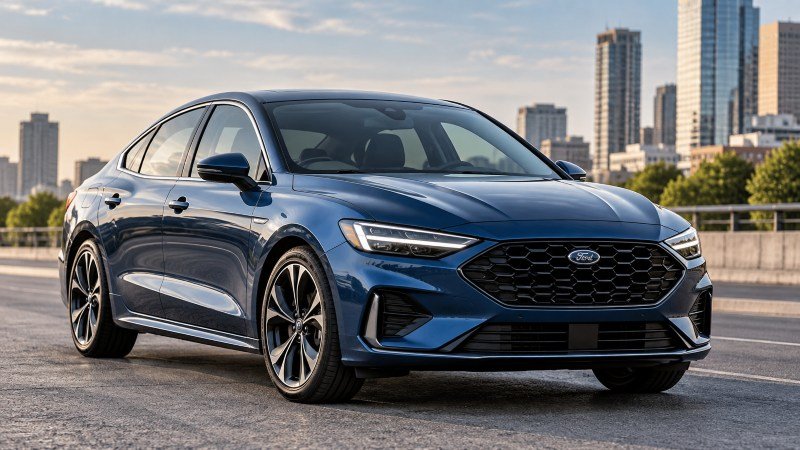
Ford appears ready to rethink its automotive market strategy. After years of steadily trimming its model lineup, the company is once again considering sedans. While crossovers, SUVs, and pickup trucks were previously Ford’s primary focus, a full-fledged passenger car model may now be back on the agenda.
After discontinuing the Focus and Mondeo, the American brand had all but abandoned passenger cars, but Ford is now preparing an unexpected U-turn – the future Focus could become part of a new, affordable lineup.
The Focus stands out as the most likely candidate for a comeback. It was a cornerstone of Ford’s lineup for years before production was gradually phased out. The Mondeo’s departure alongside the Focus left the brand with very few options for customers who still prefer traditional sedans.
The New Ford Focus
The new Focus currently exists only in renderings, but it looks completely different. Designers have opted for a larger, more substantial body. The front end echoes the styling of larger Ford models, including the Taurus.
The dominant visual element is a large radiator grille. It occupies a significant portion of the front fascia, making the sedan appear wider. The headlights, by contrast, feature a minimalist design. Horizontal light units visually stretch the front end, while modern LED internals create a high-tech look.
The lower front bumper incorporates sporty accents, ensuring the car doesn’t come across as merely a dull family sedan. If this styling makes it to the production model, the Focus could retain its brand identity while ushering in a whole new design era.
The rear of the Focus may also come to resemble more expensive models. In the renderings, the car features wide horizontal taillights connected by a light strip. This design cue is widely used by manufacturers today, as it visually widens the body and gives the vehicle a more premium appearance.
This approach is particularly effective for compact or mid-size sedans, making the car look larger than it actually is. At the same time, the rear isn’t cluttered with decorative elements; the focus remains on the broad light signature and crisp body lines.
As a result, the potential new Focus looks more like a downsized premium model than a budget city car. Of course, it is too early to say for certain that the production Ford Focus will look exactly like this. The renderings are not official company materials; they merely reflect designers’ visions of the vehicle’s potential future.
Gasoline, hybrid, or electric?
Another key aspect concerns the powertrains. Judging by the published information, Ford does not intend to limit the new lineup exclusively to electric vehicles. Future models are expected to be compatible with multiple powertrain types: traditional gasoline engines, hybrid systems, and fully electric units.
Just a few years ago, a compact sedan with a gasoline engine was considered the standard choice. Today, however, manufacturers must cater to several distinct buyer groups, as explained by the Indy Auto Man car dealership’s experts. When searching through cars in Indiana for sale, some seek the lowest possible fuel consumption and a familiar ownership experience; for them, a gasoline version or a standard hybrid would be suitable. Others are ready to switch to an electric vehicle but want a familiar body style, a spacious interior, and an affordable price point. For this audience, an electric Focus would be a logical solution.
Thus, the model’s potential return might not simply be the revival of an old nameplate, but the creation of an entirely new vehicle offering multiple powertrain options.
Why Did Ford Decide to Return to Sedans?
At first glance, the decision seems odd. For several years, the company had been reducing its passenger car lineup, citing shifting consumer preferences. Now, however, Ford may be adopting a completely different strategy. The primary reason is production economics.
If a single technical platform can produce a sedan, a crossover, a minivan, and a pickup truck, development costs for each vehicle can be significantly reduced. Shared components, electronic systems, powertrains, and software will be used across multiple models. It is precisely this kind of standardization that could make the sedan profitable again.
Furthermore, Ford faces competition beyond just traditional American and European manufacturers. Chinese brands are actively expanding into the global market, offering vehicles with extensive equipment at relatively low prices.
If Ford can offer a modern sedan with an attractive design, a reasonable price, and competitive specifications, the model stands a chance of regaining its market position. However, the main challenge lies not in creating the car itself, but in making it affordable enough while remaining profitable. This is precisely the problem Ford failed to solve in the past. Whether the company has found a new solution – we’ll see soon.

Malik Bilal is a business strategist and Editor at Outstanders, specializing in business, technology, health, and general-interest content. With more than 4 years of experience in business and technology writing, he creates insightful, research-backed articles designed to educate, inform, and inspire readers. His expertise lies in breaking down complex topics into clear, actionable content while maintaining high editorial standards, accuracy, and trustworthiness.